All New
GPS ProAll New
GPS Pro
The Blue Original
GPS

All New
GPS ProThe Blue Original
GPSUse a CR1225 lithium coin cell. Do not use a BR1225.
Insert it at an angle, toward the tab spring, with the negative side facing the transmitter. Do not push it straight down. That can damage the tab spring.
Find the threads before you tighten. Turn the lid counter-clockwise with firm pressure until the thread clicks into place. Remember that angle against a mark on the lid. Then screw the lid on. Crossed threads are not covered by the warranty.
Clear the timer on a new cell. Install the battery upside down for a few seconds, then install it the right way. The timer keeps counting even while the transmitter is off.

At room temperature the Micro transmits for about 30 hours of normal use, then gives a double beep every 10 pulses. After that warning it runs about 68 hours more, about 96 hours in total. With the magnetic switch, you can get about thirty one-hour flights from one cell.
Apollo 13 Mode starts after ten hours of continuous running. The pulses get shorter and less frequent. A new battery then lasts about five more days, or about three and a half days if the bird was lost just before the low-battery beep.
These times are approximations. They are not guaranteed. Change the battery when you hear the double beep. The small cell has less margin than a larger transmitter.
For a very cold flight, or any flight that might run overnight, use a new battery. A new cell works down to minus 40 degrees Celsius (minus 40 degrees Fahrenheit). After 48 hours of normal use, the same cell may not work below minus 18 degrees Celsius (0 degrees Fahrenheit). Shelf life is about seven years. You can leave a cell in the Micro for up to six months.
Touch the magnet to the case near the antenna base. You will hear 5 fast beeps on the receiver when it turns off, and 3 fast beeps when it turns on. The short wait keeps a brush of the magnet from turning it off by accident.

On a tail mount or a backpack, keep the magnet away from the tail spring. A magnetized spring can affect the switch. Practice a quick tap on the battery lid. With a very weak battery, the magnetic switch may not respond. If you lose the magnet, unscrew the lid and take the battery out. Listen for the signal before you fly and after you switch it off.
Length varies from one transmitter to the next. Measure the old antenna, or keep it, and cut the new one to the same length. The replacement comes with instructions. Use only a genuine Marshall antenna with Power Line Static Protection.
Unscrew the antenna protector.
Unscrew the old antenna with your fingers.
Screw the new antenna on hand tight. A small bead of quick-drying epoxy at the base is fine.
Put the protector back on.
Do not use liquid super glue or a thread locker. Super glue runs up the threads and bonds to the antenna stud. Unscrew the old antenna with your fingers only. Pliers can damage the transmitter.
Tested past 100 miles, line of sight, on the bird. In the western deserts of the United States, hunts have run from 2 to 25 miles, depending on height, ground, obstacles, and radio noise. Higher ground gives more range.
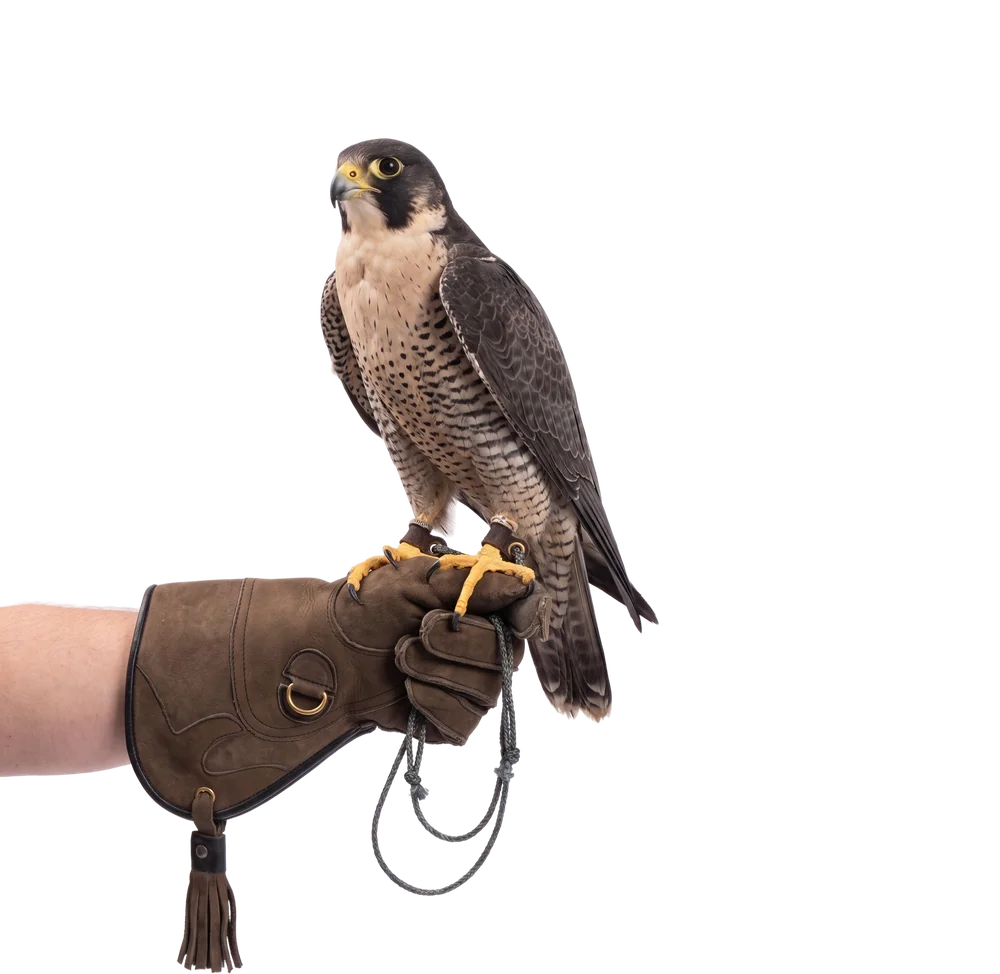
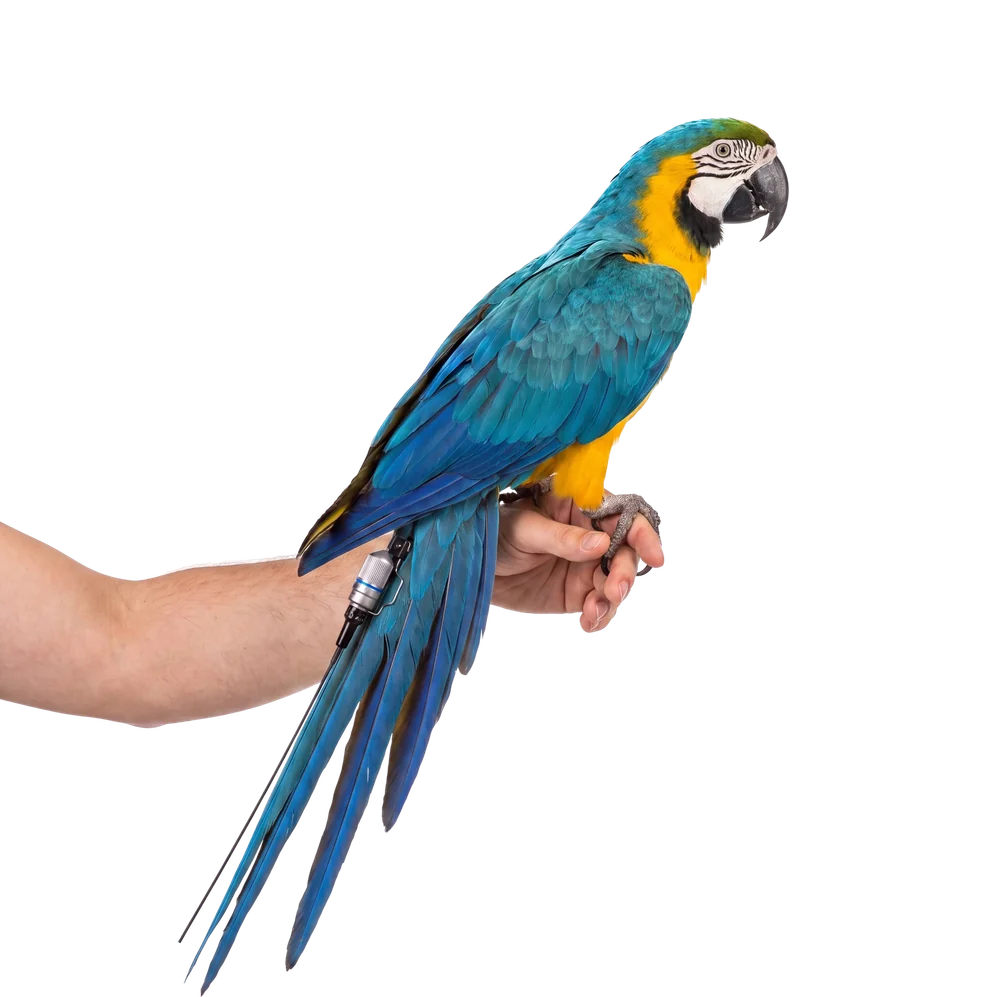
Match the photo to the hardware you ordered. The bird photos show the leg and tail methods. They use a GPS transmitter so you can see where the hardware sits.


The signal from the Micro is strongest when the receiver antenna lines up with the transmitter antenna.
A bird on a perch holds its tail nearly straight up. Hold the receiver elements straight up.
A bird on the ground can leave the antenna nearly flat. Turn the elements flat and listen again.
If you can hear the signal both ways, use the flat position to pinpoint the bird.
On a perch

Hold the elements straight up.
On the ground

Turn the elements flat.
The channel can be changed without opening the case. The range is 216.000 to 219.995 megahertz on 216 megahertz models, and 173.000 to 173.995 megahertz on 173 megahertz models. Pulse width, pulse rate, and the low-battery point can also be changed. The defaults are 43 pulses per minute, 40 milliseconds, and about 24 hours before low-battery mode. Send it to Marshall Radio. The charge is 35 dollars plus shipping, with same-day turnaround.
Work down this list before you change anything else.
The cell will not go in. Use a CR1225, not a BR1225. Slide it in at an angle toward the tab spring, negative side toward the transmitter. Do not push it straight down.
The lid will not start. Turn it counter-clockwise with firm pressure until the thread clicks, then screw it on. Remember that angle. Crossed threads are not covered by the warranty.
A new cell still shows a low-battery warning. The timer was not cleared. Take the cell out. Install it upside down for a few seconds, then install it the right way.
It dies in the cold. Coin cells lose cold-weather current as they age. Use a new cell for overnight or very cold flights. After 48 hours of normal use, the same cell may fail below 0 degrees Fahrenheit.
The magnetic switch does nothing. The cell may be too weak. On a tail mount, the spring may be magnetized. Tap the battery lid, and keep the wand away from the spring.
The range is short. Get to higher ground. Hold the receiver elements straight up for a bird on a perch, and flat if the bird is on the ground.
Marshall Radio Telemetry warrants that the Micro transmitter will be free from defects of workmanship and materials for three (3) years from the date of purchase by the end user. Return a defective transmitter directly to Marshall Radio Telemetry and we will repair or replace it and return it free of charge. Damage from misuse or normal wear and tear is not covered, and the warranty is void if a non-Marshall antenna has been used. Marshall Radio is not responsible for damages or loss beyond the value of the transmitter itself, including but not limited to the loss of a bird or lost time.
This device does not interfere with television reception or Federal Government radar.
Remove any dirt, debris, or buildup accumulated from the previous hawking season before packing your gear away.
Store all equipment in a cool, dry area where it remains safe from dust, dirt, and grime accumulation.
Take out batteries before storage, lightly clean the contacts using rubbing alcohol on a cotton swab, and wipe down the exterior with a damp cloth.
Inspect antennas carefully and replace any unit that is kinked, damaged, or exposing internal metal filaments.
Store batteries in a cool, dry place—using vapor-proof containers in humid areas—and isolate them so they cannot touch, short-circuit, or overheat.
Charge all rechargeable batteries to 100% prior to long-term offseason storage in addition to keeping them in a cool, dry location.
Ship your equipment within 3–4 weeks of purchasing service; unreceived items without an update will be automatically refunded by week 4, requiring re-payment if sent later.